How to Build an ADHD Morning Routine That Actually Works

Coronavirus and ADHD – The Unique Challenges
March 19, 2020
The Best Chore Charts for Kids with ADHD (And Why They Work)
August 5, 2026
Mornings with an ADHD child can feel like a daily emergency. The alarm goes off, and within 20 minutes you have reminded your child to get dressed four times, found one shoe, negotiated over breakfast, and watched the bus pull away from the curb. If this is your morning, you are not dealing with a discipline problem. You are dealing with a brain that struggles to initiate tasks, sequence steps, and manage time — all of which are required in abundance between 7 and 8 a.m.
According to the CDC’s 2024 national survey data, an estimated 7 million U.S. children aged 3–17 have a current ADHD diagnosis. Nearly 78% of them have at least one co-occurring condition — anxiety, sleep disorders, or sensory sensitivities — that makes mornings even harder. The strategies below are designed for how the ADHD brain actually works, not how we wish it would.
Why Mornings Are Especially Hard for Kids with ADHD
The ADHD brain has genuine difficulty with task initiation — getting started on something that is not immediately interesting or rewarding. Getting dressed, eating breakfast, and brushing teeth are all low-stimulation, repetitive tasks that the ADHD brain resists. Add in the time pressure of a school bus, a parent who is also trying to get ready, and the sensory challenges that many children with ADHD experience (scratchy clothes, loud sounds, bright lights), and the morning becomes a perfect storm.
The NIMH (updated December 2024) notes that ADHD involves real differences in executive function, including the planning and sequencing abilities that a smooth morning requires. Knowing this shifts the goal from “why can’t my child just do this” to “what external support does my child need to do this.”
How to Build an ADHD Morning Routine That Sticks
Step 1: Start the Night Before
The most effective morning routines begin the evening before. Clothes laid out, backpack packed, lunch made, and a visual checklist of the next morning’s steps reviewed together before bed. This eliminates the decision-making that slows down ADHD mornings and reduces the number of things that can go wrong between waking up and walking out the door. A child who has already decided what they are wearing is not a child who spends 15 minutes staring at their closet.
Step 2: Build a Visual Routine Chart
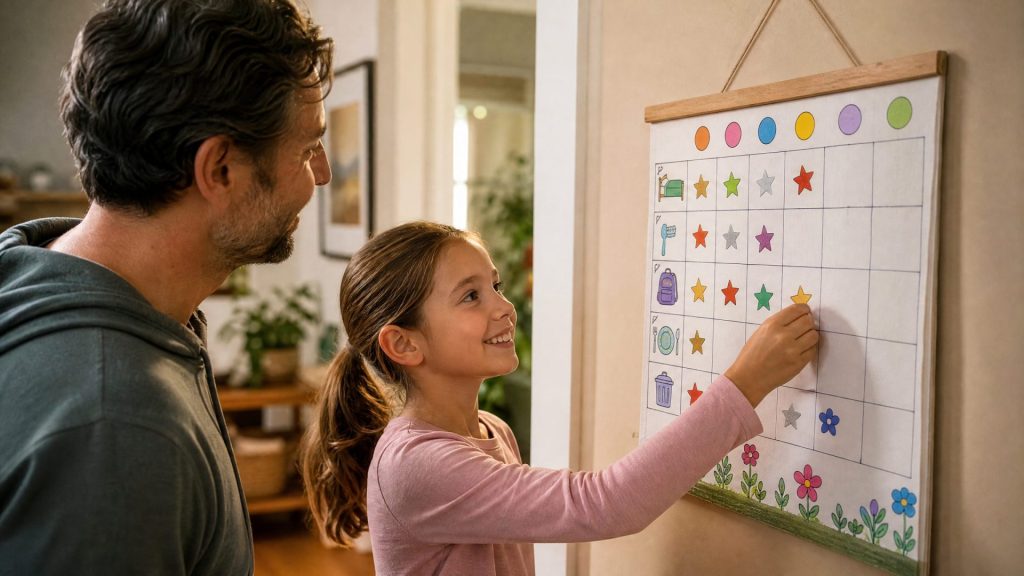
A written or picture-based morning checklist posted at eye level in the bathroom or bedroom gives your child an external reference for what comes next — which is far more effective than verbal reminders from a parent. The checklist should be sequenced (get up, use the bathroom, get dressed, eat breakfast, brush teeth, get backpack, shoes on, out the door) and should use pictures for younger children or simple text for older ones. The goal is for your child to be able to move through the routine by checking the list, not by asking you what to do next.
Step 3: Use a Visual Timer
Children with ADHD have a poor internal sense of time — a feature of the condition sometimes called “time blindness.” A visual timer (the Time Timer brand is widely used in ADHD families) shows time passing as a shrinking colored area, which makes the abstract concept of “you have 10 minutes” concrete and visible. Set it for each segment of the morning: 10 minutes to get dressed, 15 minutes for breakfast. When the timer runs out, the next thing starts — no negotiation.
Step 4: Build In a Movement Moment
Many children with ADHD are more regulated and cooperative after physical movement. A short burst of activity — jumping jacks, a quick walk around the block, or even dancing to one song — can significantly improve the quality of the rest of the morning. This feels counterintuitive when you are already short on time, but five minutes of movement often saves 15 minutes of resistance later.
Step 5: Remove Screens Until the Routine Is Complete
Screens are the single most common morning derailment for children with ADHD. The dopamine hit of a phone or tablet makes every other morning task feel even more aversive by comparison. A firm rule — no screens until shoes are on and backpack is at the door — removes the competition. It will be resisted at first and then become normal. Hold the line.
What to Do When the Routine Breaks Down
Every routine breaks down sometimes. The goal is not perfection — it is a default pattern that reduces the number of mornings that go badly. When things fall apart, resist the urge to have a long conversation about it in the moment. A brief, calm “that was a hard morning — let’s figure out what got in the way tonight” is more productive than a debrief while everyone is already late and stressed.
If mornings are consistently difficult despite a solid routine, it may be worth talking to your child’s pediatrician about whether the timing of ADHD medication is affecting morning functioning. This is a medical conversation, not something to adjust without guidance.
For more on building systems that reduce daily friction, see our guide on homework help for children with ADHD.
Browse our full library of ADHD parenting resources for children — tools for every part of the day, not just mornings.
Frequently Asked Questions
How long does it take to establish a morning routine with an ADHD child?
Most families see meaningful improvement within two to three weeks of consistent implementation, but the first week is often harder than before you started — because you are changing a pattern and your child is testing whether the new rules are real. Consistency matters more than perfection. If you skip the routine on weekends, it will take longer to stick on weekdays. The more consistent the routine across all mornings, the faster it becomes automatic.
My child wakes up in a terrible mood every day. Is that ADHD?
Sleep problems are extremely common in children with ADHD — the CHADD resource on ADHD and sleep disorders notes that up to 70% of children with ADHD have sleep difficulties. If your child is consistently waking up dysregulated, it is worth evaluating whether they are getting enough sleep and whether the quality of their sleep is adequate. A child who is chronically sleep-deprived will have significantly worse ADHD symptoms, including morning mood and behavior.
Should I reward my child for completing the morning routine?
Yes, especially in the early stages. A simple sticker chart where completing the morning routine earns a sticker, and a set number of stickers earns a small reward, provides the immediate positive feedback that the ADHD brain needs to build new habits. Over time, as the routine becomes automatic, the external reward can be faded. The goal is to build the habit first, then rely on the intrinsic satisfaction of a smooth morning as the reward.
What if my child has sensory issues that make getting dressed a battle every morning?
Sensory sensitivities are common in children with ADHD and can make clothing a genuine source of distress rather than defiance. Strategies that help include choosing clothes the night before (giving the child control and time to adjust), buying seamless socks and tagless shirts, and allowing the child to wear the same comfortable outfit repeatedly if it reduces friction. If sensory issues are significantly affecting daily functioning, an occupational therapist who specializes in sensory processing can provide targeted strategies.